A Beginner's Guide to Ordering Wine in London Bars
Orange wine, pét-nat and corkage explained in plain English, plus two London wine bars where you can put it all into practice.
A wine list can feel like an exam you did not revise for. The good news is that most of the vocabulary is simpler than it looks, and a decent bar would rather you asked a question than pointed at the third line down and hoped. This guide covers the terms you are most likely to meet on a London list, with two real places to try them.
Start with the glass, not the bottle
The by-the-glass list is the friendliest part of any wine menu. It lets you try several things without committing to a whole bottle, and it is usually where a bar shows what it is excited about. Some of the most interesting wines on a short list are there precisely because the staff want people to taste them.
Practical habits that help:
- Ask what is open. Wines poured by the glass are generally the ones already opened, so ask which are drinking best today.
- Describe what you like. Crisp and citrusy, soft and fruity, or something with a bit of grip all give staff something to work with. You do not need technical language.
- Ask for a taste. If you are torn between two, asking is normal in a wine bar.
- Check the measure. Glass sizes vary from place to place, and I could not source a London-wide standard, so look at the menu or ask before you order.
Orange wine without the mystique
Orange wine is simply white wine made with skin contact, meaning the juice stays in touch with the grape skins rather than being pressed off straight away. It is not made from oranges. According to Forest Wines, it is the oldest known method of making white wine, and it is still used in Georgia and Greece.
What does it taste like? Skin-contact wines can bring grip, orange peel and a tea-like texture, as Cave Bristol describes. If you normally drink white wine and find it a little thin, the texture is the thing to notice. It sits somewhere between white and red in feel, and it often works well with food that is salty, spiced or fried.
Pét-nat, decoded
Pét-nat is short for pétillant naturel, French for naturally sparkling. The wine finishes its single fermentation inside the bottle, a approach known as the ancestral method. It is bottled before the first fermentation has finished, with no added secondary yeast or sugar, which is a key difference from the way Champagne is made.
A few things to expect when one turns up in your glass:
- It may be cloudy. That is normal and not a fault.
- The colour can be anything. Decanter notes that pét-nat runs from pink to orange to red.
- The style varies a lot. Cave Bristol points to Portuguese rosé that can be crunchy and red-fruited, and an Italian bottle-fermented white that can be nutty and saline.
So if you try one and do not love it, try another. The category is wide enough that one bottle tells you very little about the next.
Natural, organic, biodynamic: three different words
These get used as if they were interchangeable, and they are not. Time Out's guide to natural wine separates them: organic wines use no pesticides or artificial fertilisers, while biodynamic wines are usually organic but add mystical beliefs to the ecological practices. Natural wine is its own conversation again. If a menu uses the word and you are unsure what it means in that bar, ask. It is a perfectly reasonable question.
Corkage, in general terms
Corkage is a fee a restaurant charges for opening and serving a bottle you have brought yourself. That is the whole idea. What it costs, and whether it is offered at all, varies by restaurant and changes over time, so I have not named any current deals here. My sources on specific policies were out of date and I could not confirm any of them.
What I can say is that the etiquette is steady. Advice from a head sommelier, reported by Yahoo Lifestyle, runs along these lines:
- Tell the restaurant in advance, for example in the booking note.
- Offer the sommelier a taste if the bottle is special.
- Take a second bottle from the restaurant's own list.
Ask before you book, and check the current policy directly with the restaurant. That is the only reliable way to know.
Two places to practise
Gordon's Wine Bar, Embankment
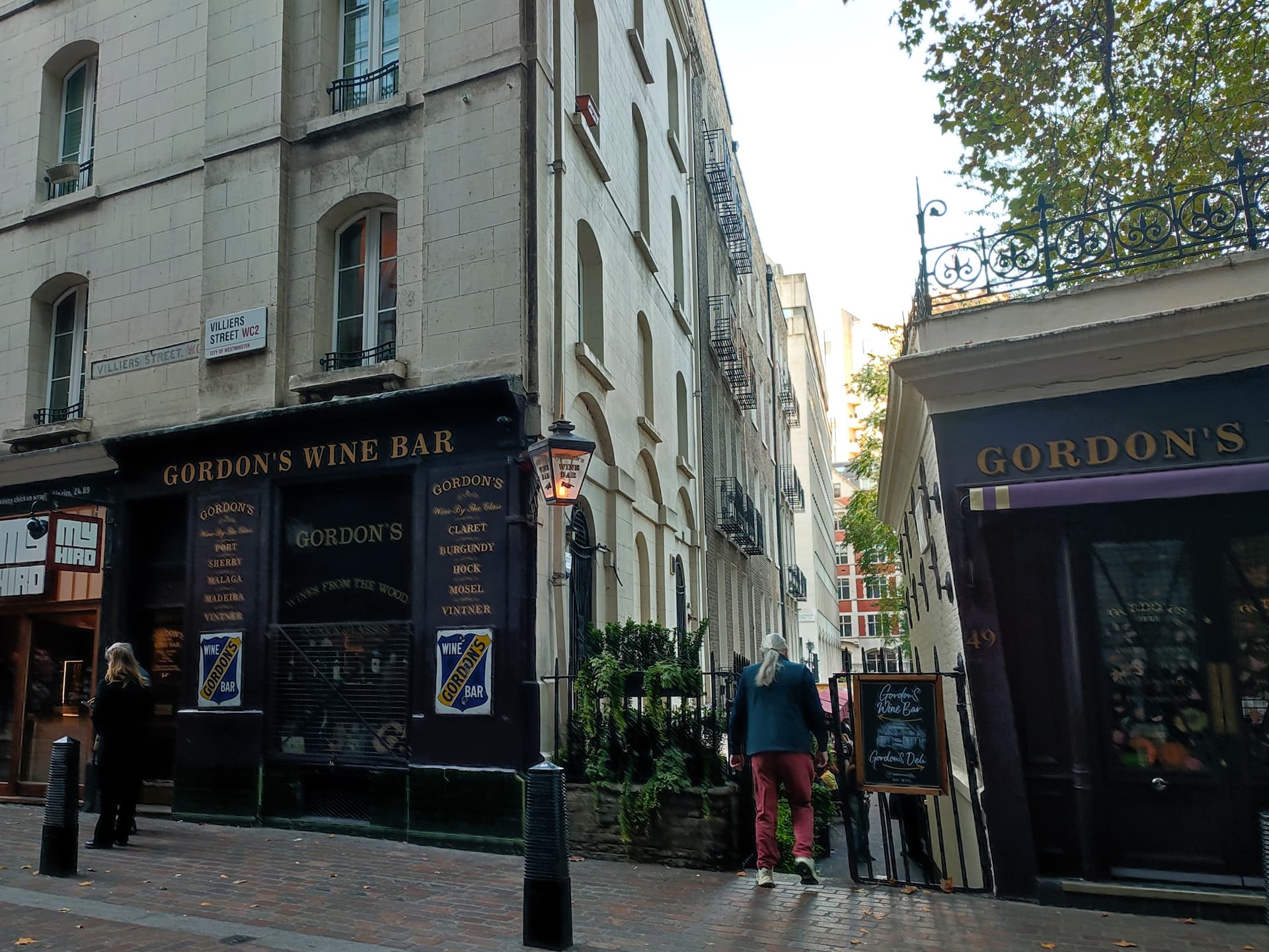
At 47 Villiers Street, Gordon's is described by The Nudge as one of London's oldest wine bars, with candle-lit cellar tunnels and a story that Rudyard Kipling once drank there. It sits close to Embankment station, and Charing Cross is also very near. The bar's own site gives hours of 11am to 11pm Monday to Saturday and 12pm to 10pm on Sunday, with the kitchen open from 12pm until 10pm Monday to Saturday and until 9pm on Sunday. It lists the bar as family friendly and pet friendly.
The Nudge says online reservations are for groups of 8 to 10 only, and that the terrace is closed on Mondays, so smaller parties should expect to turn up and find a spot. I have no verified price band, so check before you go.
Noble Rot, Lamb's Conduit Street, Bloomsbury
Noble Rot began as a wine magazine in 2013, and its own site says the Bloomsbury site opened in 2015, in a townhouse dating to 1701. The address is 51 Lamb's Conduit Street, WC1N 3NB. Its FAQ says this site has both a wine bar and a restaurant. Falstaff notes that the wine list has previously won Wine List of the Year.
I could not verify opening hours, nearest station or prices for this one, so look those up on the venue's site before you set off. As a long and well regarded list, it is a good place to practise asking questions.
A short script for your next order
- Ask which wines are open by the glass.
- Say what you usually drink and what you would like to try that is a bit different.
- If the word is unfamiliar, ask. Orange, pét-nat and biodynamic are all fair game.
- Ask for a taste if you are unsure.
- Confirm the glass size and price when you order, since both vary.
That is really all there is to it. Nobody at a good wine bar expects you to know everything, and most would rather talk about what is in the glass than watch you nod at a list.